
- A key component of Lam’s strategy is improving the energy efficiency of our products
- Upgrades to installed systems realize immediate reduction in carbon footprint
At Lam, we aim to incorporate environmental sustainability into everything we do—from our operations and workplace practices to how we source our materials and design our products.
Lam’s commitment to sustainability includes our participation in the Science Based Targets initiative (SBTi). The initiative is designed to provide a credible, standardized framework within which organizations can set goals, measure their progress, and evaluate their plans to reduce their greenhouse gas (GHG) emissions.
- By setting a science-based target (SBT), companies commit to decrease emissions at a pace aligned with the goal of limiting global warming to 1.5°C (2.7°F).
Categorizing Emissions
Generally, GHG emissions are divided into three categories: Scope 1, 2, and 3.
- Scope 1: All direct emissions from operations and facilities that the company owns or controls. Examples include: natural gas-fired equipment and process gas used in our labs.
- Scope 2: Emissions resulting from the generation of power purchased by the company and used in its facilities and operations.
- Scope 3: All emissions upstream and downstream associated with the manufacture and transport of supplies purchased by the company and the use of products sold by the company. Importantly, our product scope 3 emissions are scope 1 and 2 emissions for our customers.
The two biggest contributors to GHG emissions associated with Lam's products come from energy and process chemistries consumed in use. Reducing energy use, decarbonizing the grid with renewable sources of energy, and identifying opportunities to reduce or replace certain process gases are important strategies to achieving our long-term goals.
Upgrading our tools plays a key role in achieving our long-term goals.
CSBG's Upgrades
When designing new systems, we place high priority on the reduction of energy consumption. It will take time for these design improvements of new systems to find their way into production at Lam and then into customer fabs.
Fortunately, more immediate benefits are available from improving the energy efficiency of systems already in the field. This is the focus of recent upgrade programs initiated by Lam’s Customer Support Business Group (CSBG).
CSBG has engineering resources dedicated to product support and continuous improvement. Upgrades recently released include the adoption of more energy efficient radio frequency (RF) generators and turbo pumps in conductor etch systems.
- New generators and turbo pumps offer energy savings ranging from 18% to 50% and can significantly reduce Scope 3 emissions and, importantly, Scope 2 emissions of our customers.
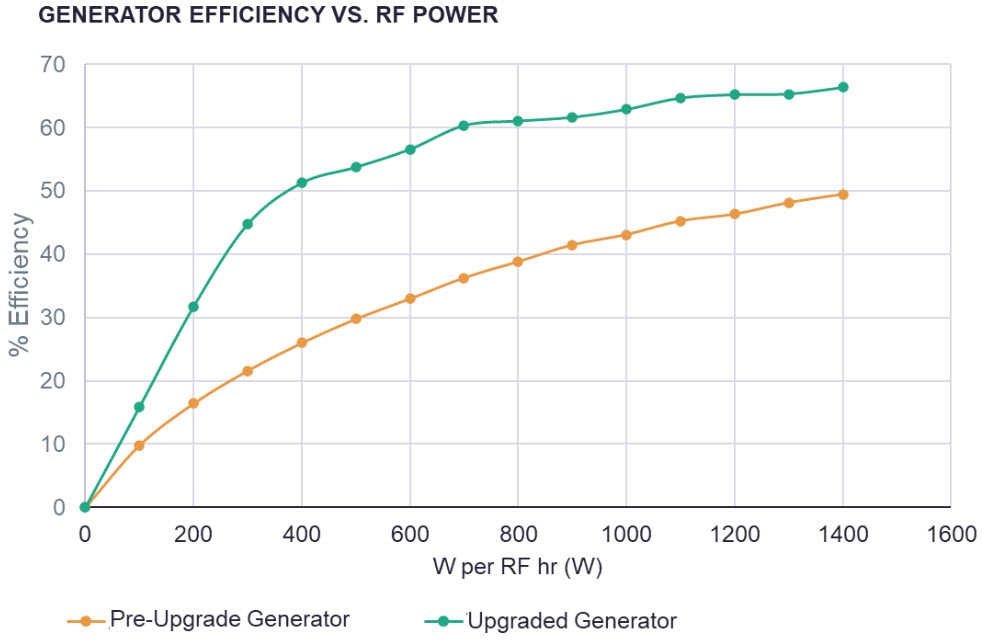
This chart shows improvements are substantial for typical process recipe power levels.
Upgrading Tools
Supporting our customers in extending the life of their existing equipment is an important aspect of our sustainability strategy. To this end, many of the technical advances we introduce in our newest products are also available as upgrades.
By utilizing these upgrades, our customers can continue to use existing equipment and extend tool performance and capabilities. Upgrading the tool enables reuse of both platform and chamber components while reconfiguring a fab to meet the requirements for new nodes and results in reduced costs. In addition, upgrading tools avoids the environmental impact of manufacturing chamber bodies and vacuum transfer modules.
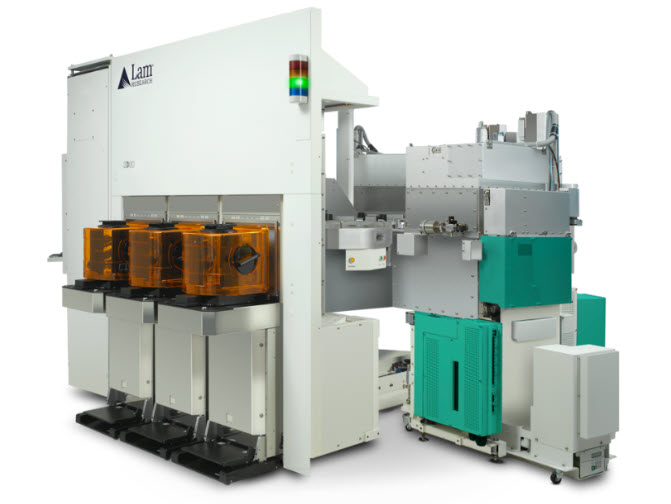
Components highlighted in green are replaced, other parts are reused
Each new system uses two to four tons of aluminum, which is avoided by upgrading the existing tool on site. This is important because every ton of primary aluminum produced emits 15.1 tons of CO2e.
By the numbers:
- In the last five years, more than 2,000 tons of aluminum production was avoided by upgrading installed base tools.
- This translates to more than 35 kilotons of carbon dioxide equivalent (CO2e) avoided from the aluminum manufacturing process.
Upgrading installed base tools is important to reduce Lam’s carbon footprint. Through improving the energy efficiency of these tools, we can support customers in reaching their internal emission targets.
Dale Olson is director, CSBG Upgrades