
- Close collaboration with customers leads to rapid and predictable achievement of cost goals
- Part lifetime, part refurbishment, and Equipment Intelligence® services optimize running costs
In the world of chipmaking, you may not necessarily think about the spare parts that a manufacturing tool uses as it builds the chip. Even more so than most factory machinery, chipmaking tools operate in extreme environments and create wear and tear on component parts, so spares are very much part of the equation.
Lam Research’s spare parts programs help customers achieve their technology and cost goals by enabling tools to perform at the highest capability. One such program, Cost per Wafer Pass (CpWP), allows customers to better predict expenses, and improve manufacturing cost efficiency.
Reducing Costs
The market demand for cheaper memory chips with increased storage capacity is unyielding. Memory producers are always on the lookout for cost-per-bit reduction strategies that allow them to stay market competitive.
Storage technologies (like NAND) have evolved from planar structures to 3D structures/stacks, which require deep etches. These etches are aggressive on process chamber parts, so they need frequent replacement.
“Our CpWP program helps chipmakers achieve low and predictable tool operating costs," says Radha Nayak, VP and GM Spares, Customer Support Business Group (CSBG). “These programs are multiyear partnerships that allow customers to pay for spare parts based on the number of wafers they process through their Lam tools. Customers engaging in this contract receive sequential year-over-year reductions.”
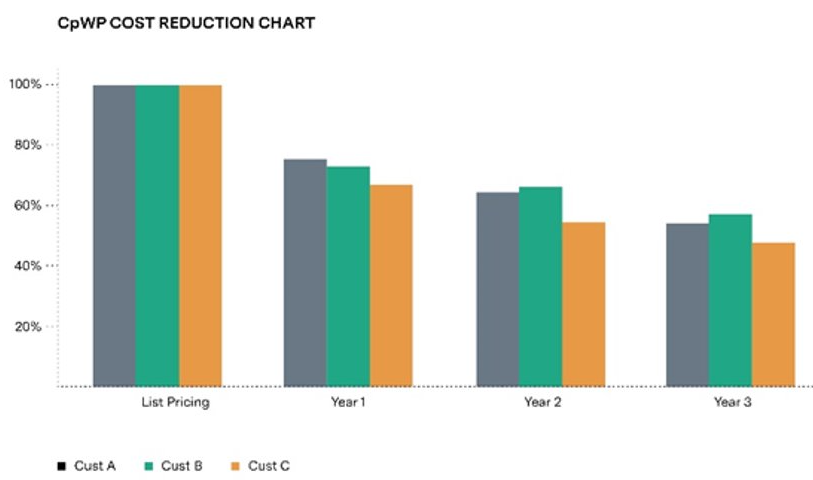
- CpWP covers the most complex and high-consumption parts, such as electrodes, edge rings, and electrostatic chucks, thus having the potential to reduce customers’ costs where it matters most.
- Predictable spending lets customers know how much they will spend on each process module over a given year. Moreover, customers are protected from cost variations across tools.
Optimizing Processes
CpWP optimizes diverse aspects of running cost—part lifetime, recipe process time, and part re-clean/refurbishment—to deliver spending reductions and predictable expenditures, as well as delivering parts without the overhead of multiple (and variable) part transactions. The use of Lam’s Equipment Intelligence® solutions ensures that we minimize variability in part and chamber level distributions to maximize productivity.
The benefits of the CpWP program include:
- Seamless adoption of updated part designs developed through collaborating on cost reduction roadmaps with customers.
- Paying for only what is needed; customers do not need to hold inventory of extra parts or pay for warehousing costs.
- Reusing high-value spare parts through a variety of re-cleaning, repair, refurbishment, and re-coating services. Offerings can include services such as Wet Clean Optimization, which improves the speed and consistency of part wet cleans by offering Lam-certified, step-by-step video-based cleaning procedures that also enable customer self-sufficiency.
What’s more, since CpWP promotes reuse, refurbishing, and recycling of used parts, the need to continuously harvest raw materials to create these parts is significantly reduced.
- Part lifetime extension, enabled by re-cleaning services, translates to approximately $400 million of reduction in materials consumption per year.
- Part reuse enabled by repair and refurbishment services translates to approximately $150 million of reduction in materials consumption per year.
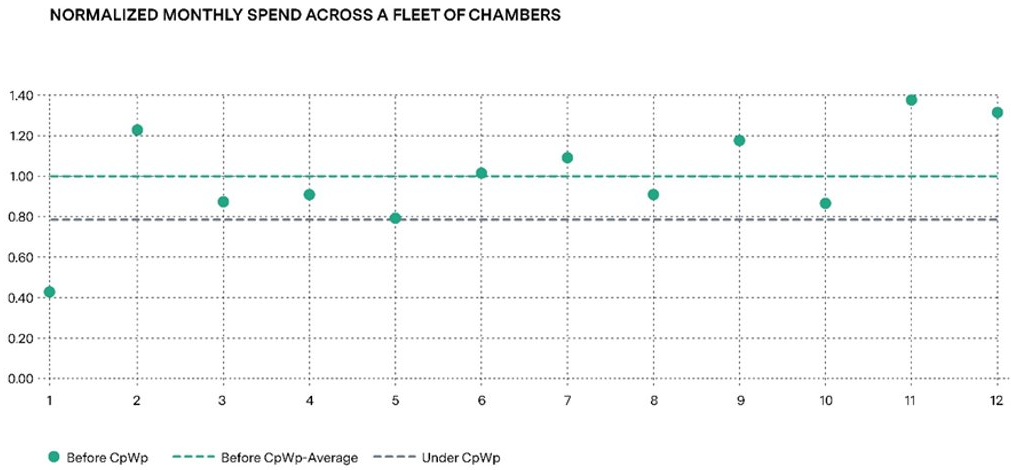
Wafer-to-wafer and chamber-to-chamber variability is eliminated
Strategic Collaboration
“The greatest advantage of the CpWP program,” says Dave Celli, CSBG’s CVP Business Development, “is that it extends the strategic collaboration between Lam and the customer from R&D to high-volume manufacturing, while offering a predictable running cost reduction roadmap.”
Chipmakers are continuously looking for ways to reduce manufacturing costs to remain market competitive. Lam’s CpWP program eliminates chipmakers’ burden of managing spares so they can focus on what they do best: producing the next generation of breakthrough technology.
Ankush Halbe is a senior manager in Spares Product Marketing